
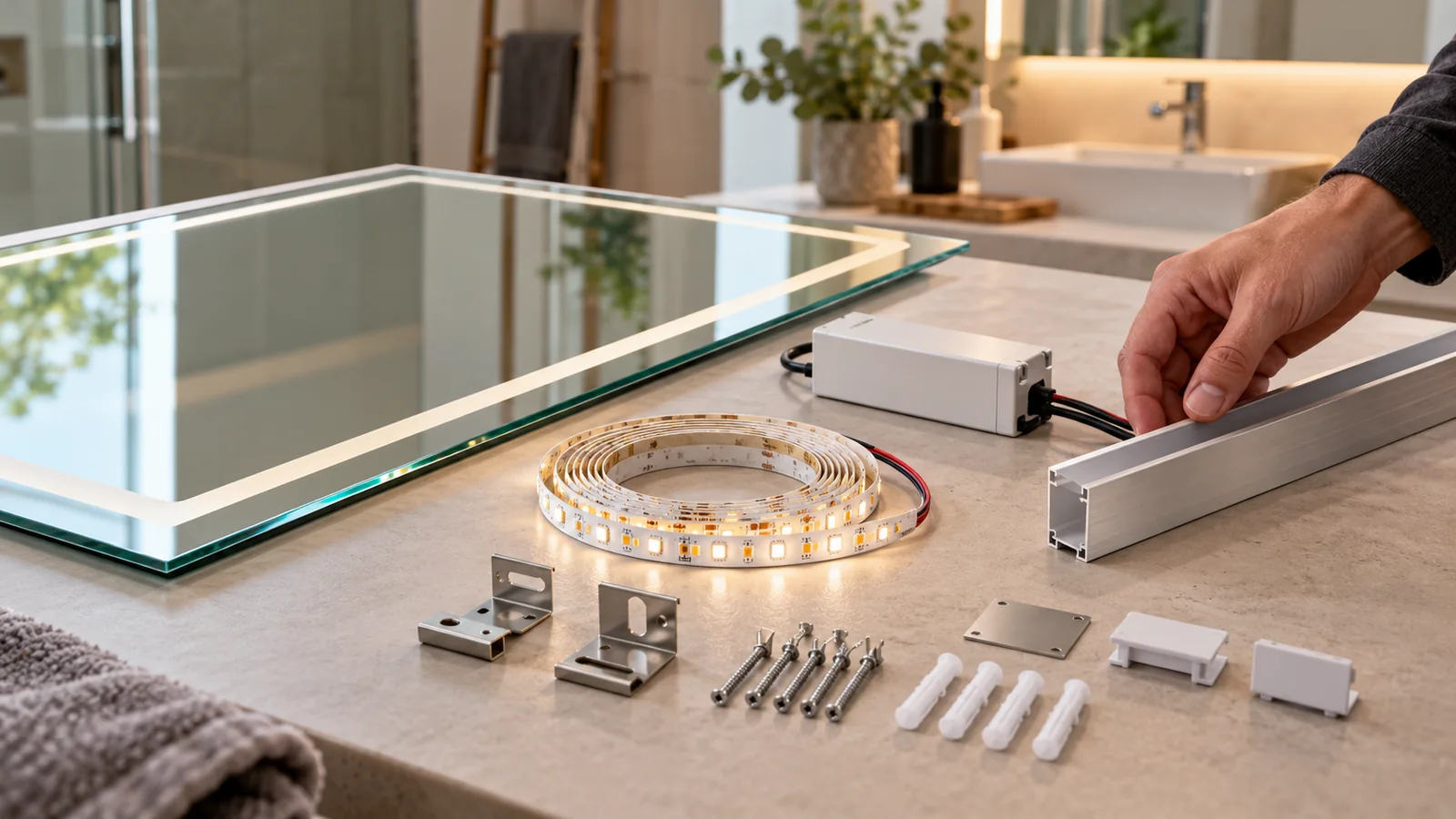
Glass and reflective surface
Ask for substrate thickness, finished dimensions, edge treatment and any specified surface treatment. The glass specification influences weight, perceived finish, edge durability and packaging design. The buyer should also define how visible blemishes will be assessed on a sample; vague requests for “perfect glass” are difficult to inspect consistently.
Different mirror designs expose different areas of glass. A frameless edge is in view and deserves close inspection. A framed mirror needs a separate fit check where glass meets the frame. None of these material descriptions should be read as a default specification for every Dongtai model.
LED strip and optical result
LED strips create the light effect, but the appearance depends on LED placement, diffuser or light-transmitting areas, the distance to the wall and the driver. Ask for the intended color temperature, control behavior, luminous performance if relevant and how the approved sample will be used to judge uniformity.
A backlit mirror may have a soft halo that changes with wall color and installation gap. Review a lit sample under realistic conditions instead of comparing isolated strip specifications. The lighting-style comparison helps decide what visual result belongs in the brief.
Driver and controls
The driver converts supply power for the LED assembly. Record rated input, output, compatibility with the chosen strip, location, access method and any control interface. A replacement part is only useful if a later maintenance team can identify its specification and reach it safely.
Do not assume that a touch control, dimmer, defogger or sensor is included simply because a similar-looking listing shows one. Put optional functions on a model-specific bill of materials and ask which electrical documents accompany the final configuration.
Frame, back structure and buying specification
For an aluminum frame mirror, check profile shape, visible finish, corner fit and the relationship between frame and mounting hardware. On any design, the rear structure determines support, wall clearance and service access. Ask for a back-view drawing and mounting instructions before the project wall is closed.
A usable RFQ lists the glass, light effect, driver input, control option, frame finish, rear fixing and packaging. Compare quotations against that same list. Substituting a driver or changing glass thickness can alter both cost and maintenance, even if the product photograph appears unchanged. See current product models for shapes to specify.
A component comparison sheet for purchasing and service
Create one line per component with specification, proposed supplier or part code where available, approved alternative and replacement route. For glass, record thickness and edge. For LEDs, record light color and control behavior. For the driver, record input and output. For frame and rear plate, record finish, mounting pattern and access method. Add carton and label identifiers because an otherwise correct unit can still be misidentified in a warehouse.
When comparing two offers, highlight every blank cell rather than assuming the cheaper offer uses the same component. Ask which parts can change during repeat orders and whether a proposed substitute requires new sample or documentation review. This sheet also helps a distributor’s service team identify the right replacement instead of guessing from the mirror’s visible shape.

